
Somewhere around mile 250 on the way to Myrtle Beach, my right hand starts talking to me. Not the polite kind of talking either. The kind where your palm goes numb, your wrist aches, and you find yourself white-knuckling the grip just to hold the throttle where you want it. I have ridden for about 35 years, and I still fight it on long days. The fix that has worked better than anything else in my garage is a Crampbuster throttle assist, a small plastic and rubber rest that mounts on the throttle grip and lets your palm do the work instead of your fingers.
This is not a cruise control and it is not a throttle lock. It will not hold your speed for you on a downhill grade, and it will not steer the bike. What it does is give your hand a place to rest, which sounds like a small thing until you have spent eight hours holding a grip open. Here is how I mounted mine, adjusted it, and learned to use it without doing anything stupid.
Your wrist does not have to take the whole trip alone
The Crampbuster throttle assist is a small, cheap part that changes how your hand rests on the grip. If you ride 100 miles or more at a stretch, this is the first thing I would add before spending money on anything fancier.
Amazon Check Today's Price on Amazon →Step 1: Know What You Are Actually Buying
The Crampbuster is a throttle-mounted cruise assist, not a cruise control. It is a curved piece of plastic with a rubber pad that clamps onto the throttle grip. The part that matters is the little wing that sticks out past the end of the grip. When your hand rests on it, the wing presses the throttle forward for you. Your fingers can stay loose. Your palm carries the load.
The one I bought is the CB4 model, part number 70-1073 on the package. The listing calls it a universal fit, and the size is listed as 1-3/8 inches, which covers the throttle grips on most modern bikes. The whole thing weighs 18.14 grams, which is nothing. You will not feel it in your pocket, and you will barely notice it on the bar. It is made of plastic and rubber, and it mounts without tools in about two minutes. Before I ordered it, I tried two other ideas and neither one stuck. A throttle lock I bought years ago held my speed fine on flat ground, but the first time I crested a long hill and the bike started running away on the downhill, I had to grab it in a hurry. After that I never trusted it. Foam grip covers were the other attempt. They made the grip fatter and my hands felt better for about an hour, but they did nothing for the constant push of holding the throttle open.
Before you order, measure your throttle grip. Most stock grips are around 1-1/8 to 1-3/8 inches, and the Crampbuster is built for that range. I measured mine with a cheap set of calipers from the garage: 1.3 inches across, right in the middle of the listed range. If you have aftermarket grips that are much thicker or much thinner, the fit gets fiddly. On my 2019 Indian Chieftain, the stock grip is right in the middle of that range, so the install was painless.
Step 2: Mount It Before a Short Ride, Not Before a Long One
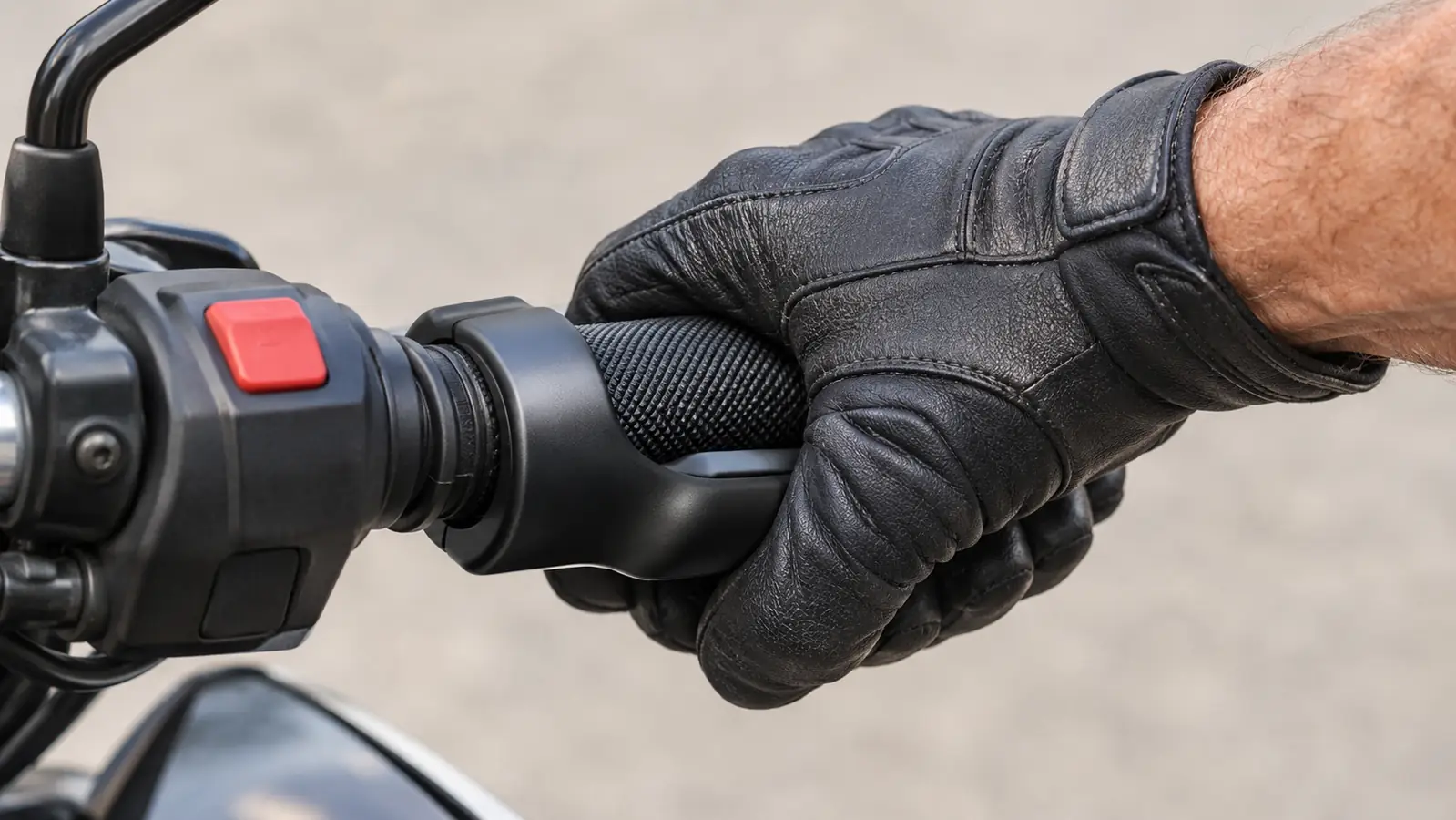
Do not wait until the morning of a 600-mile day to try this. Mount it a week ahead and take it on a few short rides first. I put mine on a Tuesday evening, four days before a planned 200-mile loop, so I had time to get it wrong before I needed it to be right. The Crampbuster does not require any tools. The bottom of the unit has a slot that hooks over the edge of the throttle grip, and the curved body wraps around the grip. You press it on until it seats, then give it a tug to make sure it is not going to spin.
The first time I put mine on, I set it too far forward. It worked, but it forced my wrist into a slightly bent position, and after 20 minutes I could feel it in my forearm. I slid it back about half an inch, and that made all the difference. The second attempt went too far the other way, and my fingers kept bumping the end of the grip. The third try was the one that stuck. Plan on two or three attempts before it feels right. The wing should sit just past the end of the grip, close enough that your palm can rest on it without your wrist bending up or down.
Here is the test I use: sit on the bike in the garage and put your hand on the grip the way you actually ride, with your elbow slightly bent and your wrist straight. The wing should meet your palm right around the base of your thumb. If you have to reach for it, move it. If your wrist is cocked, move it. It should feel like nothing when you are not thinking about it. I ran that garage test twice, then went out and did a 20-mile loop on back roads before I trusted it on the interstate.
Step 3: Adjust the Tension Before You Trust It
The Crampbuster works by letting the weight of your palm rest on the wing, which presses the throttle forward. That means how much pressure you put on it controls how much it holds the throttle. If you rest your hand lightly, the bike will slow down gradually. If you press down, you will accelerate. That is the whole trick, and it takes a little while to get the feel for it.
The first time I tried it for real was a Sunday morning on I-79 north of Pittsburgh, where the traffic is light and the road is straight. I got up to 65, took my fingers off the grip, and rested my palm on the wing. My speed did not change. I actually laughed in my helmet, because I had been fighting that little push for years without thinking about it. On a quiet road, find a safe straight stretch with no traffic behind you. Get up to highway speed, then take your fingers off the grip and rest your palm on the wing. You should be able to hold your speed with your hand relaxed. If the bike slows down, shift your hand so more of your palm is on the wing. If the bike speeds up, lighten up.
This is also where you learn the most important safety rule with any throttle assist: your fingers never leave the throttle completely. The Crampbuster is not a lock. It does not have a clamp or a lever. Your hand stays on the grip the whole time, just more relaxed. If you need to slow down, you simply lift your palm and roll the throttle closed. That is it. Do this with a full tank of gas and clear weather, and do not try it in heavy traffic until the motion is second nature.
Step 4: Use It for the Long, Boring Middle Miles
Here is where the Crampbuster earns its keep. On the way to Myrtle Beach, the first couple of hours are fine. My hand is fresh, the roads are interesting, and I do not think about the throttle at all. The trouble starts in hour three, when the road straightens out and the miles start to blur. That is when I used to find myself gripping harder than I needed to, just out of habit.
On last year's trip I hit that wall right on schedule, around mile 250. Instead of white-knuckling it to the overnight stop in Virginia, I let my palm rest on the wing and rode the next 70 miles with my fingers loose. My hand stayed in the same position, ready to grab the brake or roll off the throttle, but it was not doing any work. I could stretch my fingers out one at a time. I could shake my hand out at a stoplight. By the time I pulled into the motel, my hand felt the way it used to feel after a hundred miles, not three hundred. That was the moment I stopped thinking of the Crampbuster as a gimmick.
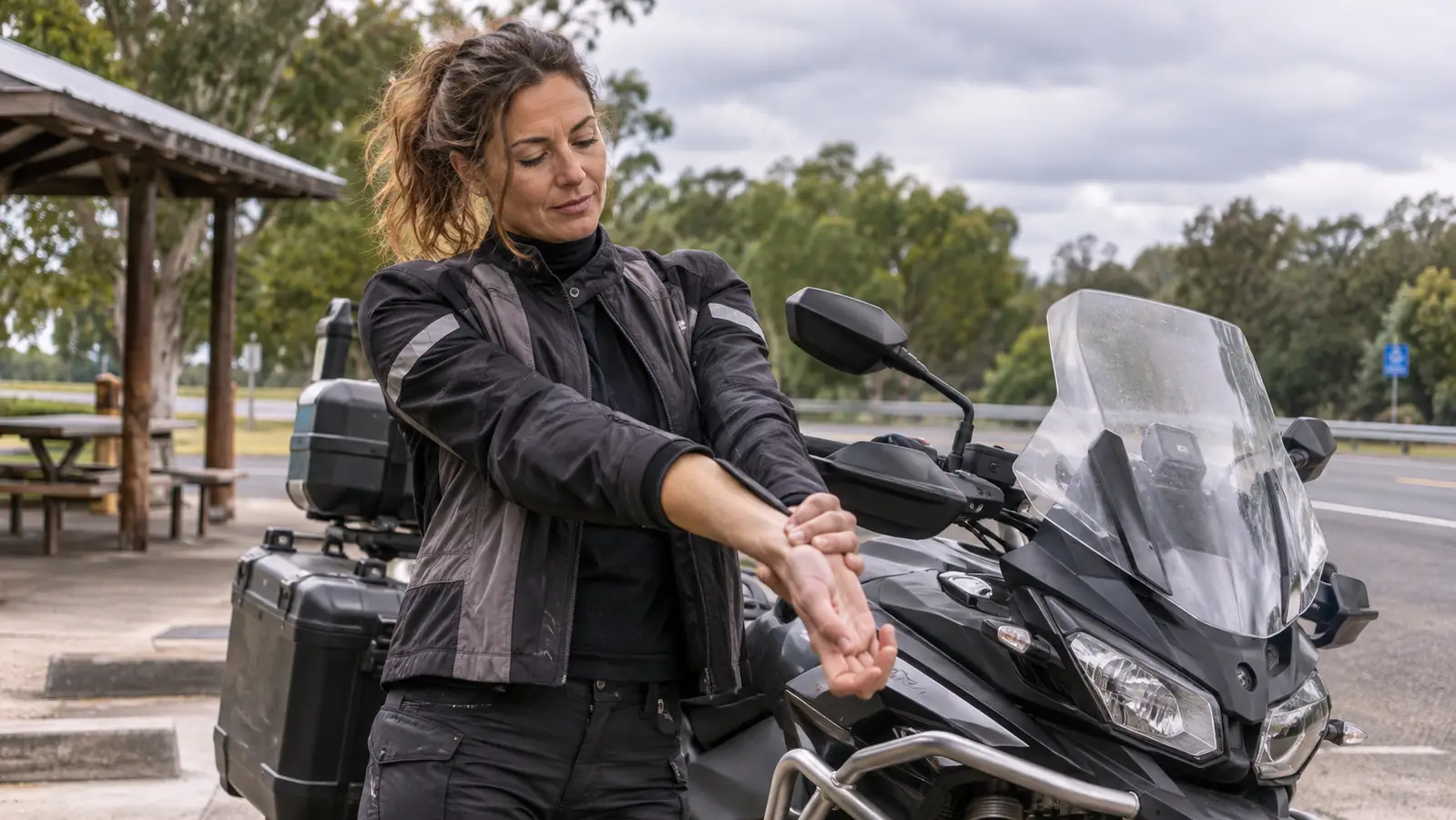
One thing I will tell you straight: it does not replace taking breaks. I still stop every couple of hours, get off the bike, and walk around for five minutes. I use those stops to shake my hand out and roll my wrist, the same way I used to stretch before a shift at the mill. The Crampbuster makes the miles between stops easier. It does not make you invincible. If your hand is already numb, stop and take a break. No gadget is worth pushing through that.
Step 5: Know Its Limits and Ride Accordingly
The Crampbuster is great on the highway, and it is not for everything. In town, in heavy traffic, or on twisty roads, I take my hand off the wing and grip the throttle normally. You want full, precise control when you are braking, turning, or filtering through traffic. The assist is a rest for the long straight miles, not a replacement for your hand.
It also will not hold your speed on a downhill. Gravity is stronger than a palm rest. If you are descending a long grade, you still need to roll off the throttle and use your brakes like you always do. And if you ride in heavy rain, the rubber pad on the Crampbuster can get slick. I have never had a problem with it, but I pay more attention to my grip when the rain starts.
The other limit is the one I mentioned at the start: it is not a throttle lock. A throttle lock clamps the throttle in place and takes your hand completely out of the equation. The Crampbuster does not do that. Your hand stays on the grip, which is exactly why I trust it. I want something that makes a long day easier, not something that lets me forget my hand is there.
What Else Helps
A throttle assist is one part of the fix, not the whole fix. The other thing that helped me more than I expected was a set of hand grips that are slightly thicker than stock. I swapped my stock grips for a set about an eighth of an inch thicker, and it took pressure off the base of my palm. A bigger grip gives your hand more surface to spread the pressure across. I also started wearing riding gloves with a little extra padding in the palm, and I do a quick wrist stretch at every fuel stop. None of that costs much, and all of it adds up.
The biggest change, though, is simply paying attention to how you are holding the grip. Most of us grip harder than we need to. The Crampbuster gives you a reason to relax your hand, and once you feel how much better that is, you start doing it even on short rides. That is the real win. The gadget is the reminder. The habit is the cure.
The Crampbuster does not hold your speed for you. It gives your palm a place to rest so your fingers can stay loose, and that is exactly why I trust it at mile 400.
Mile 400 is a lot easier with a place to rest your palm
The Crampbuster throttle assist is a two-minute install, it works with the throttle grip you already have, and it makes the long boring miles a whole lot easier on your right hand. If you ride distance at all, this is the cheapest comfort upgrade I know.
Amazon Check Today's Price on Amazon →