
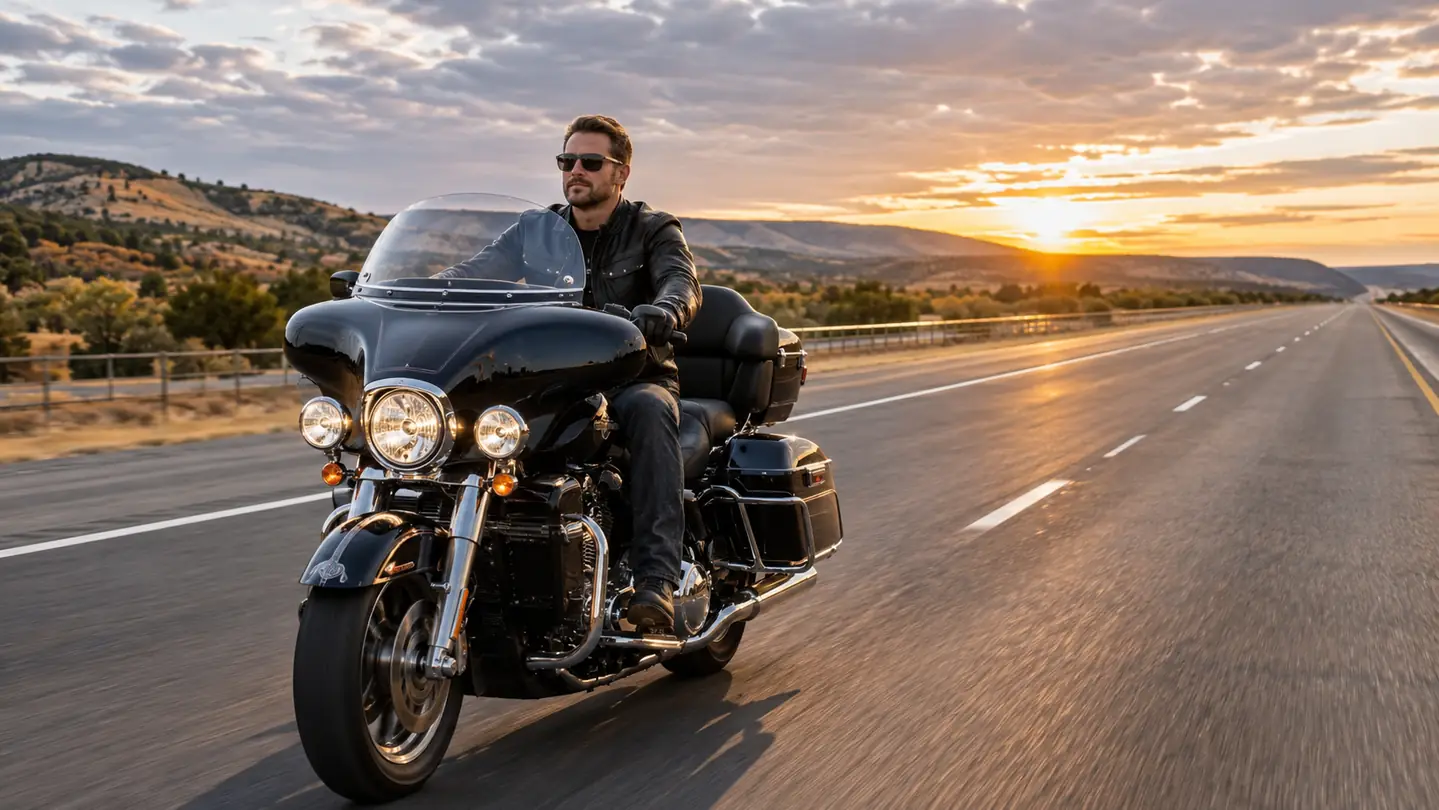
Somewhere around mile 300 of a long interstate day, your throttle hand starts making a case for a vacation. Mine does every year on the ride down to Myrtle Beach. The fix usually comes down to two different ideas: a Crampbuster, a wing of plastic and rubber that mounts on the throttle grip and gives your palm a place to rest, or a throttle lock clamp, a piece of hardware that grabs the throttle and holds your speed so you can take your hand clean off the bar. They sound like they do the same job. They do not. If you want wrist relief without ever giving up control of the throttle, the Crampbuster is the one I'd run. If you want true hands-free stretches on empty roads, that's the clamp's job. Here's the honest breakdown after a season of both.
I'm Hank, 61, retired from the steel mills outside Pittsburgh. I've been riding about 35 years, and my bike is a 2019 Indian Chieftain touring bike. Every year I ride it from Pittsburgh to Myrtle Beach, South Carolina, about 600 miles each way with an overnight stop in Virginia. Linda, my wife, rides pillion on shorter rides, but she takes the car on the beach run, which tells you something about how much of a grind the second day is. I bought both of these to answer the same question: how do I get to the beach without my throttle wrist feeling like a pipe that's been overworked at the mill.
| Crampbuster | Throttle Lock Clamp | |
|---|---|---|
| What it does | A wing on the throttle grip that rests your palm and keeps your hand in control | A clamp that locks the throttle at a set speed so you can take your hand off |
| Hands-free riding | No. Your hand stays on the grip the whole time | Yes. That's the entire point of it |
| Installation | Slips onto a 1-3/8 inch throttle grip, universal fit, no real fuss | Clamps to the handlebar and needs a few minutes of fiddling to line up |
| Weight on the bar | 18 grams. You forget it's there | A metal clamp you can see and feel every time you look down |
| Material | Plastic and rubber, 18 grams, easy on the grip | Metal, heavier, feels solid but adds bulk |
| Safety in traffic | Hand is always on the throttle, so rolling off is natural | A locked throttle needs a deliberate release before you grab the brake |
| Price | One of the cheapest comfort upgrades you can put on a bike | Costs more, sometimes several times more |
| Warranty | Manufacturer warranty | Varies by brand, check before you buy |
| Best for | Riders who want wrist relief and want to keep hand-on-throttle control | Riders who want true hands-free stretches on long, empty highways |
What Each One Actually Does
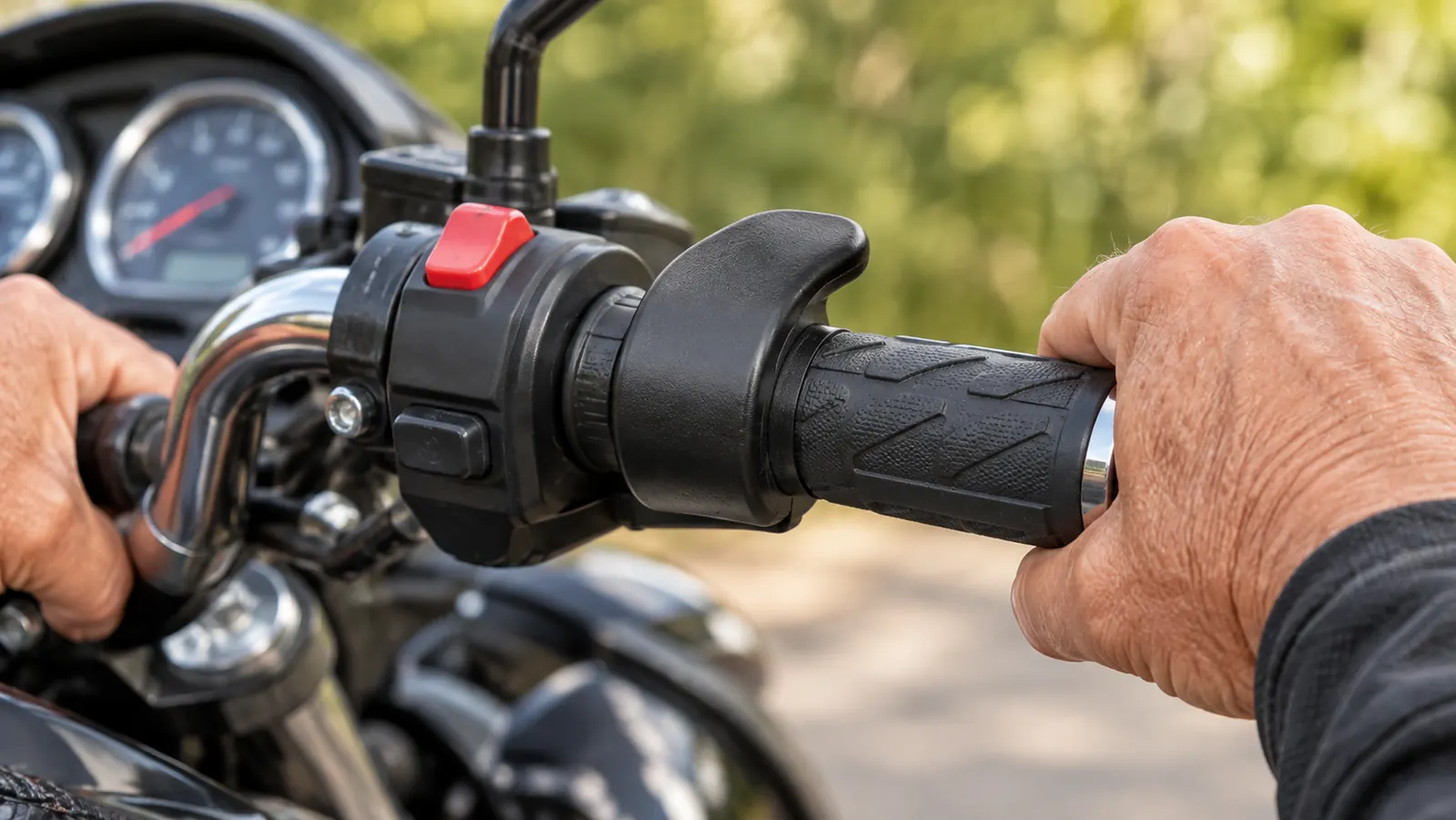
The Crampbuster is the simpler idea, and it's the one I keep coming back to. It's a wing-shaped piece of plastic and rubber that mounts right on the throttle grip. The size is made for a 1-3/8 inch grip, which covers most stock motorcycles, and the whole thing weighs 18 grams. You put it on, and when your hand gets tired, you drop your palm onto the wing. Your wrist straightens out, your arm relaxes, and the throttle stays exactly where you left it because your hand never leaves the grip. That last part matters more than you'd think.
A throttle lock clamp is a different animal. It mounts to the handlebar and, once you set it, it holds the throttle at whatever speed you choose. You can take your hand off the bar entirely, shake out the arm, flex your fingers, dig in a pocket. On a long flat interstate, that feels like a superpower the first time you try it. The tradeoff is that you've handed your speed control to a piece of hardware, and you have to remember it's doing that.
Here's the difference in one sentence: the Crampbuster changes the angle of your wrist, and the clamp changes who's holding the throttle. One keeps you in the loop, the other takes you out of it. Everything else about these two products flows from that.
Fit matters more than people think. The Crampbuster is a universal fit sized for a 1-3/8 inch throttle grip, which is what most stock bikes run, and it's made in the United States. The clamp has to match your handlebar diameter, and some bars are fatter or thinner than the clamp expects. If the clamp doesn't sit right, it can rotate on the bar or interfere with the controls. The Crampbuster either fits your grip or it doesn't, and if it doesn't, you know it in about ten seconds.
How I Tested Both
Both of these went on my Chieftain within the last couple of riding seasons, and both got the same test: a couple of Myrtle Beach trips and a lot of weekend rides. The clamp lock went on first. I set it on a long straight stretch of Interstate 81 through Virginia, took my hand off, and let out a laugh you could probably hear in the next county. Then I spent the rest of the trip re-setting it on every hill and learning, the hard way, what happens when you forget it's engaged.
After that trip I switched to the Crampbuster and just left it on. No adjustments, no re-setting, no engagement ritual. It did its job every mile, whether I was on the interstate or threading through a small town in Virginia. By the time I got to the beach, I'd stopped noticing it entirely, which is the highest compliment I can pay a piece of riding gear. The clamp, by contrast, I noticed every time I looked down at the bar.
I'll also say this about the testing: I didn't do it in a lab, and I didn't do it on a track. I did it the way you'll use it, on real roads, with real traffic, in real weather. The clamp got its fairest shot on the long empty stretches, and it still lost me on the hills. The Crampbuster never had a stretch where it didn't work.
Where the Crampbuster Wins
Start with the fact that it's always working. The Crampbuster doesn't care whether you're on a 600-mile interstate day or a 20-mile backroad loop. It's on the grip, it weighs nothing, and it changes the angle of your wrist the moment you need it. I've caught myself reaching for it in the middle of a long straight and realizing my hand had already found it on its own. That's the sign of a good piece of gear: you stop thinking about it and just use it.
Then there's the control side. With the Crampbuster, your hand never leaves the throttle. If traffic stacks up or a deer walks out, you roll off and brake exactly like you always have. There's nothing to disengage, nothing to forget, nothing to fumble for in a moment that doesn't allow fumbling. The clamp lock is only as safe as your memory, and I'll be honest with you, my memory is not what it was at 40.
It's also worth saying that the Crampbuster doesn't just help on long trips. Around town, in stop and go, in slow-speed work, it keeps your wrist in a better position the whole time. I notice it most when I'm not thinking about it, which is the whole idea.
Where a Throttle Lock Clamp Wins
The clamp's one big trick is one the Crampbuster can't touch: it takes your hand out of the equation entirely. On a long, flat, empty stretch of interstate, that's a genuine rest. I'd set it, drop both shoulders, shake out my right hand, flex my fingers, and just sit there while the miles went by. Your whole arm recovers, not just your wrist. For that alone, some touring riders swear by them, and I understand why.
The catch is everything else. A clamp lock holds whatever speed you set, so it doesn't know the hill is coming or the traffic is slowing. On rolling roads you're constantly re-setting it, which becomes its own kind of fiddle. And the one time you forget it's engaged, usually at the end of a long day when you're tired, you grab the brake and the engine keeps pulling. That's a lurch you feel in your chest. I'll take a little wrist fatigue over that feeling every single time.
Wrist tired at mile 300? The Crampbuster is the fix that stays on the bike.
I've run mine for a season and it hasn't moved, hasn't worn out, and hasn't once made me think about it at the wrong moment. It's a small, simple, inexpensive part of the bike now, and it does its job every mile.
Amazon Check Today's Price on Amazon →
The Safety Question Nobody Wants to Talk About
I'll be straight with you. I've seen riders treat a throttle lock like cruise control in a car, and it isn't. Car cruise control can cancel itself when you touch the brake. A clamp lock just holds the throttle. If you're not paying attention, it will hold the throttle right into the back of a semi. That's not a knock on the hardware. It's a fact of how the thing works. The Crampbuster can't do that because it doesn't hold anything. It only rests your palm.
Here's the other thing I noticed. With the clamp, I'd set it and then my attention would drift, just a little. Because my hand wasn't doing the work, my brain checked out a bit. With the Crampbuster, my hand stays in the loop the whole time, so my head stays in the loop too. On a long day, that's worth more to me than a fully rested arm.
One more thing, and I want to be fair to the clamp here. If you're the kind of rider who checks your gear the way I check my bike before a trip, who runs through the same routine every time you get on, a throttle lock can be perfectly safe. My argument was never that the hardware is dangerous. It's that it asks something of you, every single time, and on a long day you may not have it to give.
It weighs 18 grams, and it changed how my right hand feels at mile 400 of a 600-mile day.
What Surprised Me
The thing I didn't expect is how much of the clamp's benefit you get from the Crampbuster. Not the hands-free part, you don't get that, but the actual rest. When your palm is on the wing, your wrist is straight, and a straight wrist doesn't need to grip anything. The throttle stays put because the weight of your hand is holding it, not because your fingers are clamped around it. My hand came off that 600-mile day a lot less cooked than I expected.
The other surprise was how little the Crampbuster gets in the way. I was sure a wing on the grip would interfere with my hand position or make the controls feel crowded. It doesn't. It sits there, out of the way, until you need it. I loaned my bike to a buddy for a run to the store, and he came back asking what that thing on the grip was, because he'd used it without even thinking about it.
And the durability surprised me too. Eighteen grams of plastic and rubber sounds like it would break the first time you knock it against something in the garage. Mine has been knocked against the workbench and generally treated like shop gear, and it's still on the grip doing the job. The clamp, by comparison, developed a wobble in its mount that I had to tighten twice.
Who Should Buy Which
Buy the Crampbuster if you ride long miles and the problem is your wrist, your grip, or your arm angle. If you want to keep your hand on the throttle, which I think you should, and you just want the fatigue to stop, this is the answer. It's also the answer if you ride varied roads, because it works every mile, not just on straight highway. And if you're riding a bike with stock grips, which most of us are, the fit question basically answers itself. It's inexpensive, it's simple, and it never asks you to remember anything.
Buy a throttle lock clamp if you're on genuinely long, flat, empty highways and you want to take your hand off the bar for real stretches. If you understand the engagement and disengagement routine cold, and you're disciplined about it, a clamp lock is a legitimate tool. I just don't think most riders, and I include myself in this, are as disciplined as the tool demands.
Still deciding? Start with the one that never needs to be disengaged.
The Crampbuster has been on my Chieftain for a season, and it's the first thing I'd put on a new bike. If it doesn't suit your grip, you're out a few minutes of your time and a small amount of money. But I think you'll find, like I did, that the simple one is the one that stays.
Amazon Check Today's Price on Amazon →