
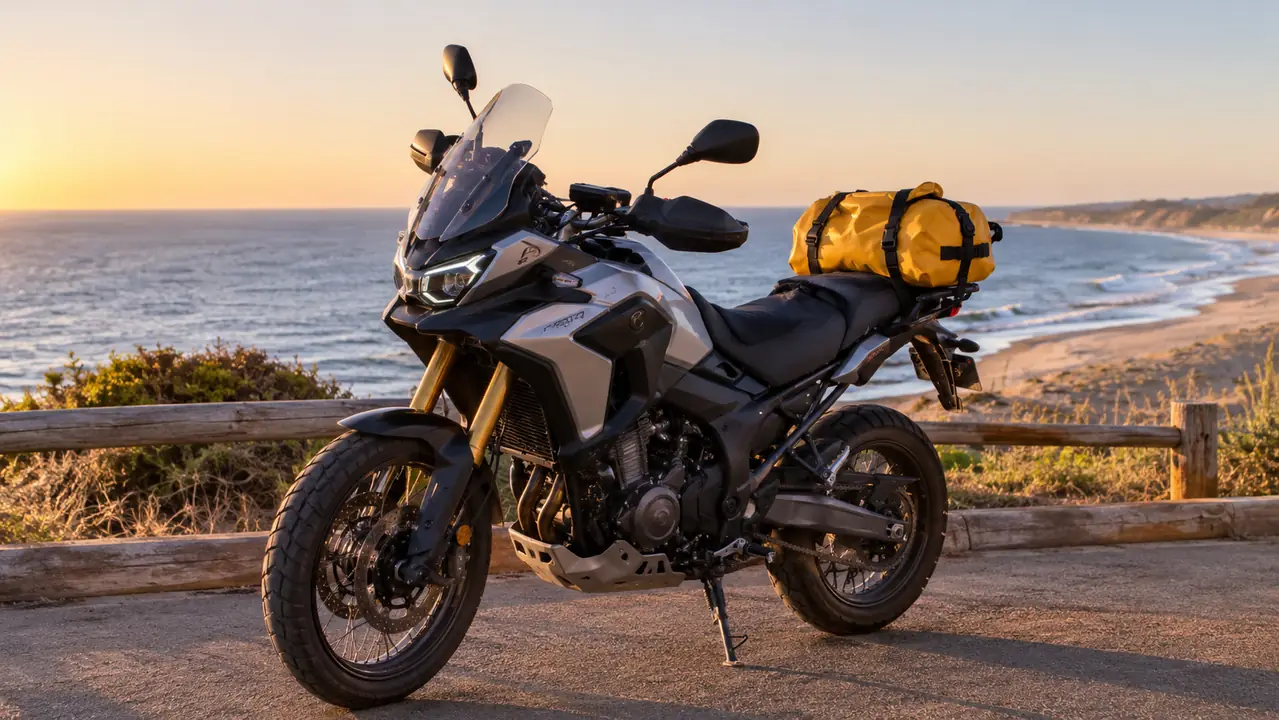
If you ride long distances, the luggage question comes down to one trade: do you want a bag that locks to the bike, or a bag you can carry into the motel? After a couple of Myrtle Beach trips with the 30-liter IRON JIA'S roll-top dry bag strapped across the passenger seat of my 2019 Indian Chieftain, I can tell you the dry bag wins most of the arguments. It is lighter, fully waterproof, and it comes off the bike in about a minute. Hard saddlebags still win the two that matter most to some riders: security and fixed load support.
Let me be clear about how I compared them. My big ride every year is Pittsburgh down to Myrtle Beach, about 600 miles each way, usually two days with an overnight stop in Virginia. Linda takes the car, so the bike carries everything I need for a week: clothes, a rain layer, toiletries, a book I never finish, and enough snacks to make a gas station clerk raise an eyebrow. I bought the IRON JIA'S last season, and it has done a couple of Myrtle Beach trips and a lot of weekend rides since. I did not bolt anything to the fender. I did not buy a mounting kit. I strapped it on and rode.
| IRON JIA'S Roll-Top Dry Bag | Hard Saddlebags | |
|---|---|---|
| Waterproofing | Roll-top closure and welded seams; fully waterproof in a downpour | Weather-resistant, but gaskets and lid seals age and can leak |
| Empty weight | 1.18 kg for 30 liters of space | Rigid shells and mounting frames add heft before you pack a thing |
| Mounting | Adjustable, removable straps; universal fit, no brackets | Model-specific mounts, brackets, and hardware per bike |
| Security | A strap cutter can take it in seconds | Lockable lids and rigid shells deter theft |
| Off-bike carry | Unstraps and carries like a duffel with a shoulder strap | Stays on the bike; you hand-carry the contents |
| Heavy loads | Soft shell sags if overloaded; keep weight moderate | Rigid shell holds heavy, awkward loads without shifting |
| Capacity options | 30L, 50L, and 70L sizes; bag compresses when not full | Fixed volume; you haul the empty space |
| Best for | Long trips, wet weather, and carrying your bag inside | Locked parking, commuting, and daily security |
Where IRON JIA'S Wins
The waterproofing is the reason I bought it. The shell is 500D PVC with high-frequency welded seams, and the roll-top closure is the same idea as a dry bag you would take kayaking. I have hit a solid two hours of rain on I-77 south of Charlotte and pulled into the motel to find my clothes as dry as the day I packed them. Hard bags are weather-resistant, not waterproof. Their gaskets dry out, the latches collect grit, and a hard bag that has been on the road for a few seasons will leak through the lid seal long before a roll-top will.
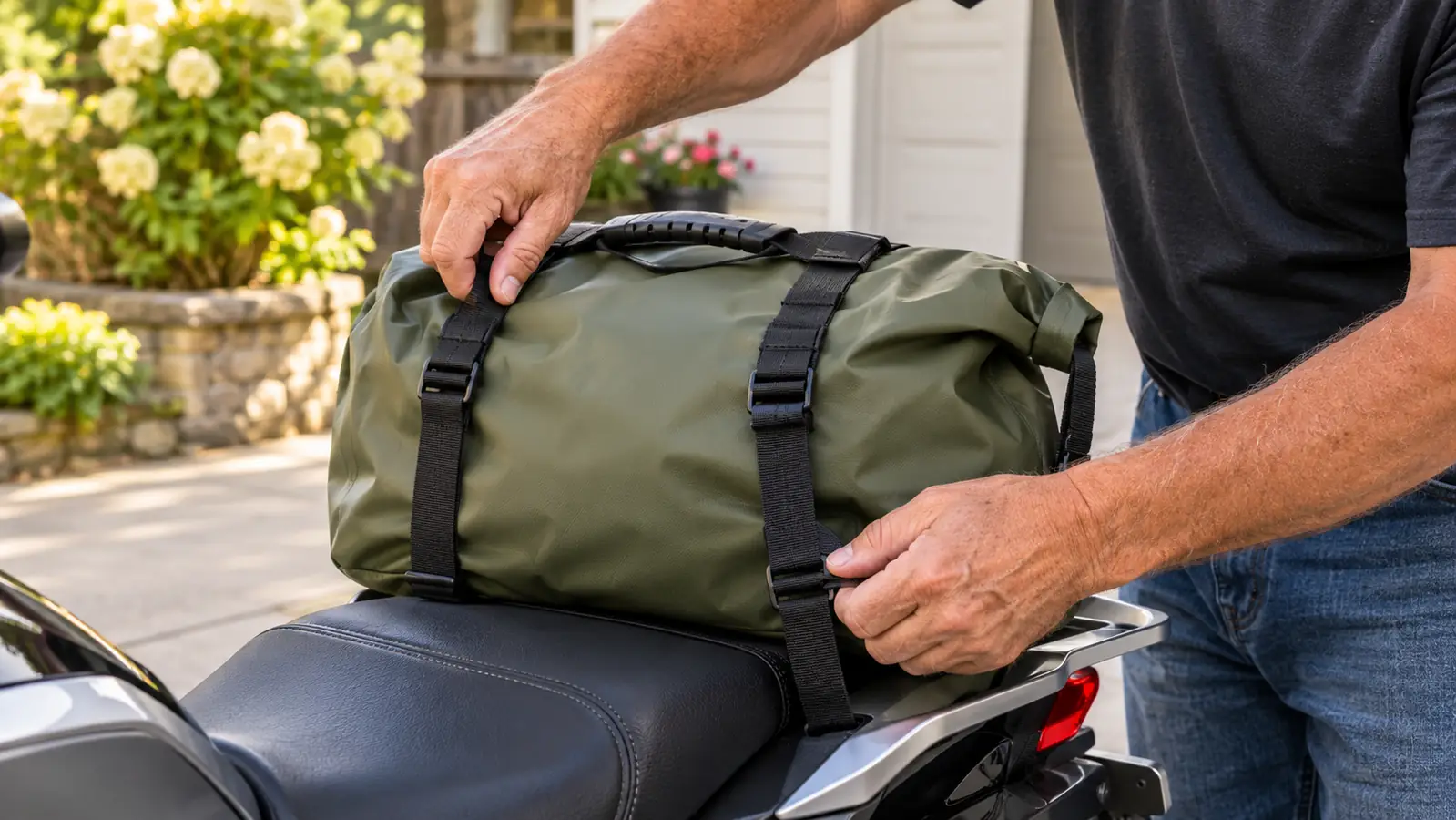
The other thing I did not expect is how much I like taking the whole bag inside. The IRON JIA'S mounts with adjustable, removable straps, so it sits on the passenger seat against the backrest without any brackets. At the end of the day I unclip it, sling the shoulder strap, and walk into the motel with one bag over my shoulder. That is a bigger deal than it sounds. You are not unloading a saddlebag armful by armful at the end of mile 400. You are not leaving your clothes in a box bolted to the bike overnight. The bag weighs 1.18 kg empty, so you are not hauling a steel frame around whether it is full or not. At 30 liters it holds a week of warm-weather riding, and the same bag comes in 50 and 70 liters if you pack for cold weather or camping. Inside, a pocket swallows a 15-inch tablet, which is where the charging cables and the sunglasses live.
Where Hard Saddlebags Win
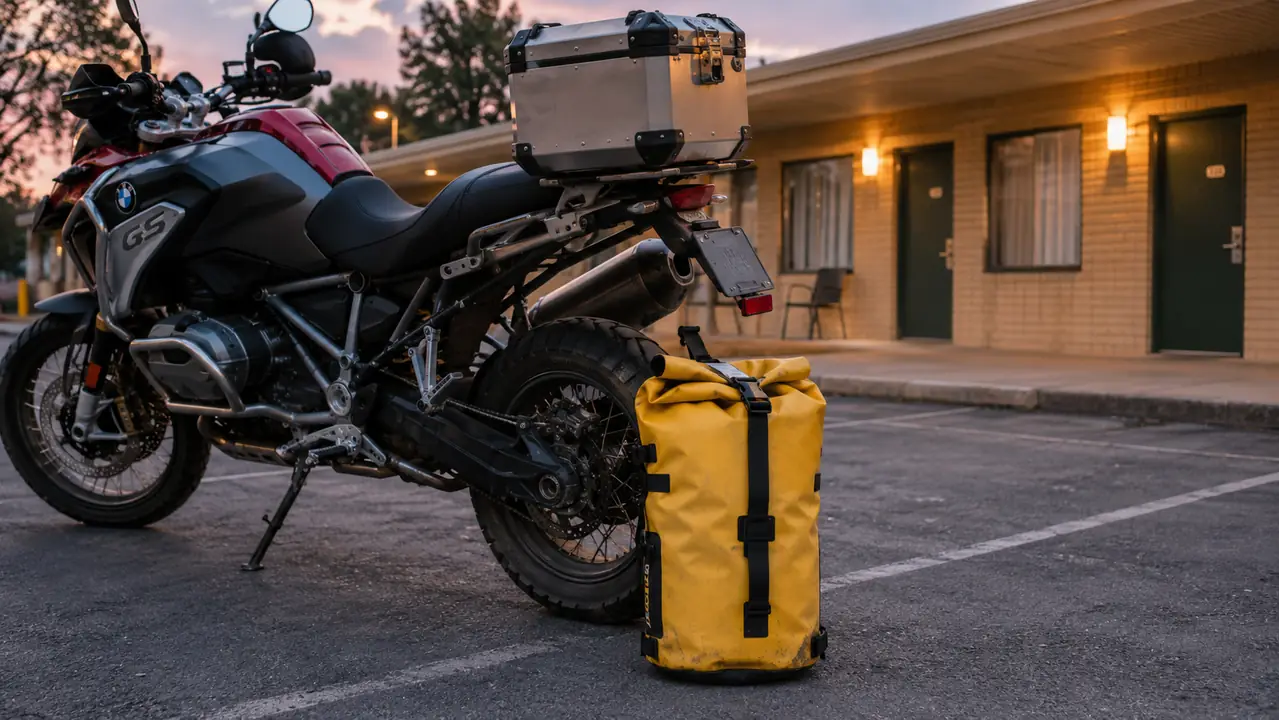
I am not going to pretend the dry bag is a vault. It is a fabric bag with straps. If you park overnight where someone can work on it undisturbed, a knife through a strap defeats it in seconds. Hard saddlebags with lockable lids and rigid shells are the honest answer for that. If I commuted daily and parked in a lot, or if I regularly left the bike loaded overnight in a public place, I would want hard bags and their locks.
Hard bags also win on carrying heavy, awkward things. A rigid shell bolted to the frame does not flop or sag. You can load tools, a chain, groceries, whatever, and the bag holds its shape and keeps the weight where the bike expects it. A soft bag is only as stable as the straps holding it. Load the IRON JIA'S sensibly, keep the weight moderate, and it behaves. Overload it and the whole bundle starts to sway, which is the last thing you want at highway speed. I keep the heavy stuff low in the bag and I do not fill it to the brim.
If your miles end at a motel, not a parking lot, the roll-top is the better choice.
The 30-liter IRON JIA'S gives you waterproofing, a shoulder strap for the walk inside, and no brackets to bolt on. Check today's price on Amazon and see if it fits your seat.
Amazon Check Today's Price on Amazon →What a Week on the Road Taught Me
Packing a soft bag is a skill. I roll my clothes instead of folding them, put the rain layer on top so it is the first thing out, and keep the inside pocket for the things I need before I find the motel door: charger, sunglasses, the paperback that has been on every trip for three years. The roll-top takes three folds and a clip, and that is the whole closing ritual. No zippers to jam, no lid to align, no gasket to seat. You close it the same way every time and it is the same seal every time.
On the bike, the bag sits behind me against the backrest, and the straps tighten down so it does not wander. I check the straps at fuel stops, same as I check everything else. With the weight kept low and the bag not overstuffed, I have never felt it move the bike. At 30 liters it is the right size for a week of warm-weather riding. If I were packing for cold weather or camping gear, I would step up to the 50L or 70L that the same bag comes in.
The shoulder strap is the feature I did not expect to care about. A hard bag stays on the bike, which means at the end of the day you carry armloads of stuff through the parking lot and down the hall. The IRON JIA'S unclips and becomes a duffel. One trip, one bag, one shoulder. After a long day in the saddle, that is a small mercy, but it is the kind of small mercy you remember.
Two hours of rain south of Charlotte, and my clothes came out of the bag as dry as the day I packed them.
Who Should Buy Which
Buy the roll-top dry bag if your trips end at motels, if you ride in weather, or if you like the idea of one bag that does luggage duty on the bike and duffel duty off it. Buy it if you are tired of brackets and want something that transfers from one bike to another without a parts list. The IRON JIA'S is a universal-fit bag with adjustable, removable straps, and that is exactly what a rider who changes plans a lot wants.
Buy hard saddlebags if your bike sits parked in public for hours at a stretch, if you commute daily and carry the same load every day, or if you routinely haul heavy gear that a soft shell cannot support. Hard bags are the right tool for a locked, permanent load. They are just the wrong tool for a rider who wants to carry his bag into the motel and his clothes into the laundry room.
And if you are genuinely torn, start with the soft bag. It fits the bike you have right now, it comes inside at night, and it will teach you what you actually carry. If you later decide you need locks and a rigid shell, you will know exactly why, and you will not have wasted the miles.
The One Thing Nobody Tells You
Nobody tells you that the luggage question is really a parking question. If you park where you can watch the bike, a soft bag is fine and the flexibility is worth it. If you park where you cannot watch it, no amount of convenience fixes a cut strap. Decide where the bike sleeps before you decide which bag to buy. That single question settled it for me.
For me, the answer was easy. My bike sleeps in the driveway at home and in motel lots on the road, and the bag comes inside every night. The only time it sits on the bike unattended is during a fuel stop or a meal, and I can see the bike from the window. That is a parking plan the dry bag can live with. If your parking plan is different, your luggage answer will be different too.
What I'd Tell a Younger Rider
If I were 30 again and setting up a bike for the first long trip, I would buy the soft bag first and learn what I actually carry before I spent money on permanent luggage. Most riders overpack for the first two trips and underpack for the third. A roll-top dry bag forgives both. Strap it on, ride, and pay attention to what you use and what you never touch. That list will tell you what kind of luggage you really need.
The other thing I would tell a younger rider is to respect the weight. A soft bag wants moderate loads with the heavy stuff low. That is not a compromise, it is a reminder that the bike handles best when the weight is down and centered. Hard bags let you get sloppy. The dry bag keeps you honest, and honest packing makes for a better ride at mile 400.
Questions I Get About Soft Bags
Do you worry about someone stealing it? Yes, and the answer is parking. I do not leave the bike loaded overnight in a public lot. When I stop for the night, the bag comes inside with me, which is the whole point of a bag you can carry. If I had to leave it on the bike, I would run a cable lock through the straps, but I would rather just carry it in.
How does it hold up in a real downpour? The 500D PVC and welded seams are the same construction as a kayak dry bag. I have done two hours of steady rain and the contents stayed dry. I would still wrap electronics in a zipper bag inside, because that is just good sense, but the bag itself has never leaked on me.
Would you take it on a longer trip than Myrtle Beach? I would. The limiting factor is not the bag, it is the rider. At 30 liters you have to pack lean, and that is a skill. The bag itself rides steady, the straps stay put, and it comes inside at night. I would not hesitate to point it at a two-week trip as long as I packed for the weather.
Hard bags or soft bag for a first bike? If you are new, start with a soft bag. It fits any bike, it comes inside with you, and you will learn what you actually carry before you commit to a permanent mounting system.
What About the Straps?
The straps are the part people ask about most, because a bag is only as good as its attachment. The IRON JIA'S uses adjustable, removable straps, and after a couple of Myrtle Beach trips and a lot of weekend rides, mine still tighten down snug with no sign of wearing through. I run them under the passenger grab rail and around the backrest, then pull them tight and tuck the loose ends. It takes about a minute to mount and about thirty seconds to pull free at the motel.
One tip: do not overtighten. A strap pulled past snug does not hold any better, and it makes the bag harder to get off at the end of the day. Snug enough that the bag does not shift when you push on it, loose enough that your fingers can work the buckles with gloves on. That is the setting I use every time, and the bag has never moved on me.
The roll-top that has done two Myrtle Beach runs without leaking a drop.
The 30-liter IRON JIA'S is waterproof, light, and off the bike in about a minute. Check today's price on Amazon and see if it fits your seat.
Amazon Check Today's Price on Amazon →